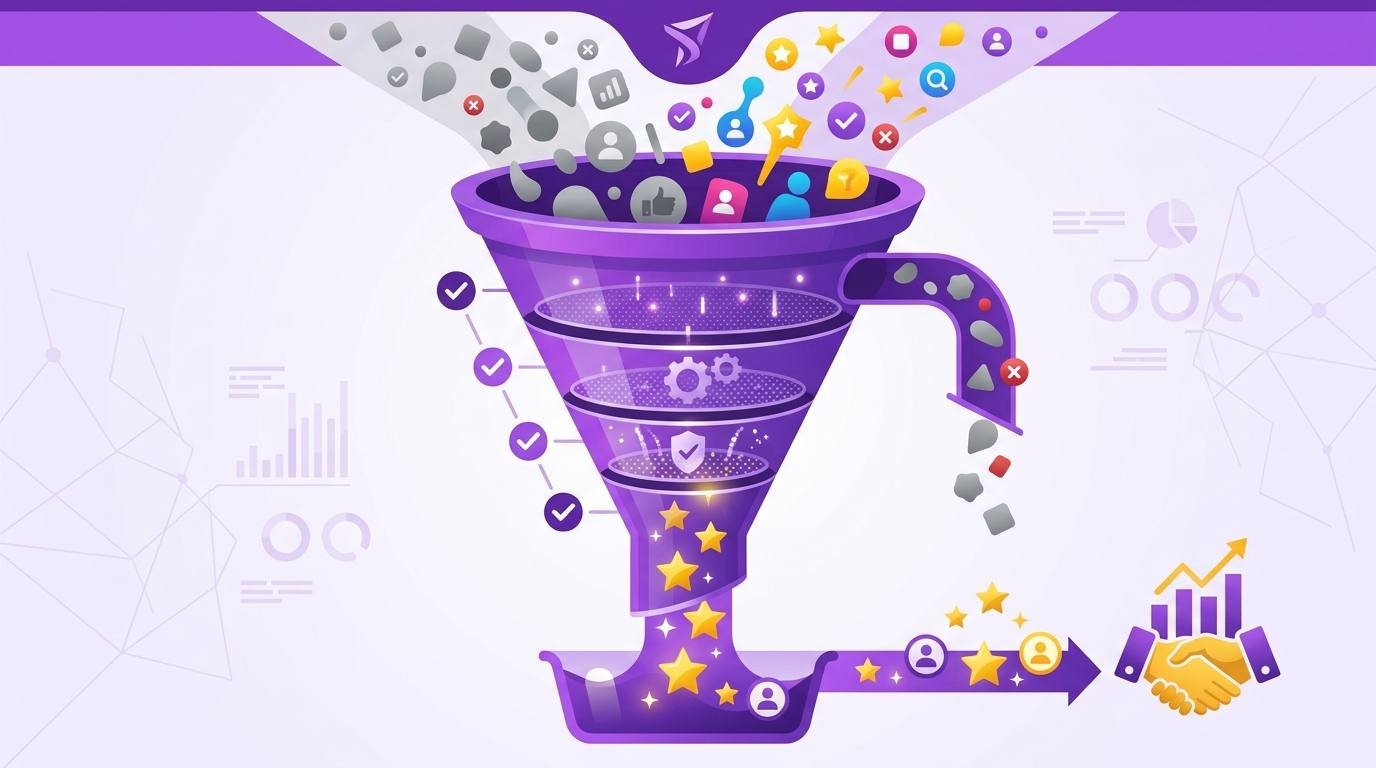
Lead Quality vs. Lead Volume: Why Fewer, Better Leads Usually Win
A thousand cheap leads feel like progress. The CRM fills up, the cost-per-lead report looks beautiful, and then the sales team starts dialing — and nothing happens. Volume is the easiest metric in lead generation to buy and the least reliable one to bank on. Here's how to define quality, measure it honestly, and structure your program so you're paying for leads that can actually become customers.
The volume trap
Low-quality volume doesn't just waste the money spent on the leads themselves. It burns the hours of everyone who touches them: sales reps chasing dead numbers, follow-up sequences mailed to inboxes that don't exist, and forecasting built on a pipeline that was never real. Worst of all, it erodes trust between marketing and sales — the moment reps stop believing in the leads, they stop working them, and even the good ones die in the queue.
The arithmetic is unforgiving. Doubling lead volume while halving contact rate doesn't keep results flat; it raises your true cost per acquisition, because every downstream cost — calling, nurturing, tooling — is multiplied by leads that go nowhere.
What "quality" actually means
Quality is vague until you break it into four checkable properties:
- Intent: did this person actually ask for something? A user who requested a quote has intent; a user who was lured by a sweepstakes entry does not, whatever the form says.
- Validity: is this a real, reachable person? Working phone, real inbox, name that matches the contact details.
- Fit: does the lead match who you can serve — right geography, right profile, right need?
- Consent: did they knowingly agree to be contacted? Beyond being a compliance requirement, consent is a strong quality signal — people who expect your call behave very differently from people who don't.
A lead that passes all four is worth paying a premium for. A lead that fails any one of them is inventory, not opportunity.
Measuring what matters
You cannot manage quality from the lead vendor's dashboard alone. The numbers that define quality live downstream, in your own systems:
- Contact rate by source: what share of each source's leads can your team actually reach? This single metric separates most good sources from most bad ones within weeks.
- Qualified rate: of the leads contacted, how many met your qualification criteria?
- Downstream conversion: appointments set, quotes issued, deals closed — tracked back to the original source, not just the campaign.
Build the feedback loop
Sales outcomes have to flow back to whoever buys the leads. A simple disposition process — every lead marked as contacted, qualified, converted, or dead, with a reason — turns vague complaints about "bad leads" into a per-source scorecard you can act on and share. This is the same discipline we apply in lead generation optimization: landing pages, forms, and verification workflows tuned against real outcomes, not surface metrics.
A simple validation stack
Quality is cheapest to enforce at the moment of capture:
- Form design with deliberate friction. One or two extra qualifying questions cost you a little volume and buy a lot of intent. Zero-friction forms maximize exactly one thing: submissions.
- Real-time verification. Validate phone numbers and email addresses as the form is submitted, and reject what fails before it enters your pipeline.
- Deduplication. Paying twice for the same person is a silent tax on every program.
- Scoring over time. As disposition data accumulates, route high-scoring leads to your best reps first — speed-to-lead matters most for the leads most likely to convert.
Aligning publisher incentives
If you pay for raw volume, you will get raw volume — publishers respond to the incentive they're given, as our guide to pricing models explains. Paying for qualified leads, with clear written validation rules and a quality bonus on downstream performance, points everyone's effort at the same target. Share your source-level scorecards with publishers who want to improve; the good ones will use them, and the rest will filter themselves out.
And where leads fail validation outright — invented data, duplicates, unreachable contacts — reject them under the written terms rather than absorbing the cost. Programs that never reject anything train their supply chain to stop trying, which is how quality problems quietly become fraud problems.
Conclusion
Quality isn't the expensive option — it's the only option that survives contact with your sales floor. Define it in writing, measure it at the source level, validate it at capture, and pay for it deliberately. If you'd like help structuring that workflow for your campaigns, talk to our team.