
Performance Marketing Guide
CPA, CPL, CPI, and CPS Explained
Understand the most common performance marketing pricing models and when each one makes sense.
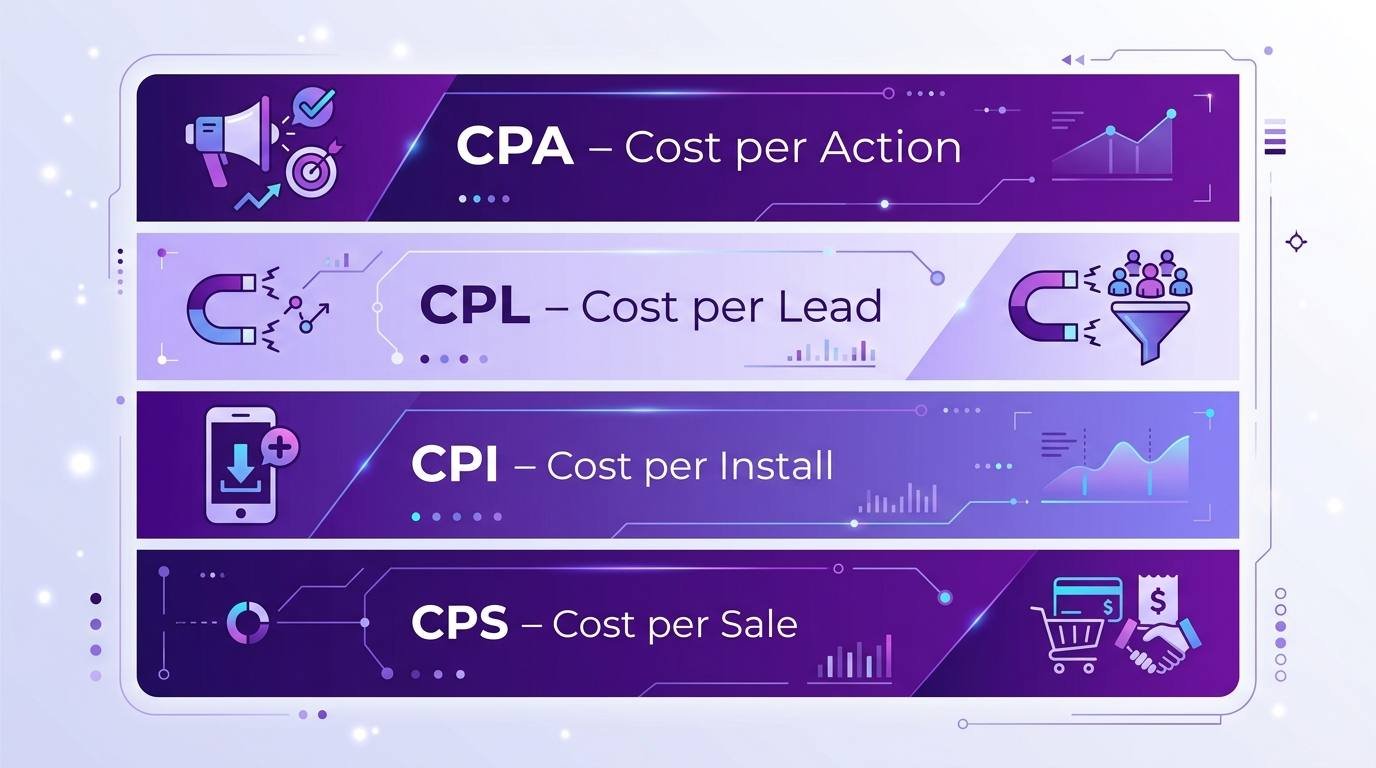
Performance marketing uses pricing models that connect media spend to measurable results. The four most common models are CPA, CPL, CPI, and CPS. Each model is useful for different business goals.
CPA means cost per action. The advertiser pays only when a user completes a specific action such as creating an account, requesting a quote, starting a trial, or completing a purchase flow.
CPL means cost per lead. This model is common in finance, home services, education, insurance, and B2B campaigns. The advertiser pays when a user submits verified contact information and meets campaign criteria.
CPI means cost per install. Mobile app advertisers use this model when the goal is to acquire new app users. Quality is usually measured beyond the install through retention, registration, or in-app events.
CPS means cost per sale. This model pays a publisher only after a purchase is completed. It is common in ecommerce, subscriptions, travel, and online services.
The right model depends on risk, funnel length, and data maturity. A new advertiser may prefer CPL to build a pipeline. An ecommerce brand may prefer CPS. A mobile app may begin with CPI and later optimize toward in-app events.
No model is automatically better than another. The best model is the one that aligns incentives between advertiser and publisher while keeping traffic quality measurable.
How Each Model Shifts Risk Between Advertiser and Publisher
Every pricing model in performance marketing is really a conversation about risk. CPA and CPS push almost all of the risk onto the publisher, since they only get paid once a sale or a defined action is fully completed. CPL shares risk more evenly, since the advertiser is paying for interest rather than a finished transaction, but still expects that interest to be genuine. CPI sits closer to the advertiser's risk side, because an install is easy to generate but does not guarantee an engaged user, which is why many app advertisers eventually blend CPI with post-install event tracking.
Understanding this risk balance helps advertisers set fair payouts. A publisher taking on more risk under a CPA or CPS model typically expects a higher payout per conversion than a publisher operating under CPL, where the advertiser absorbs more of the downstream uncertainty.
Choosing the Right Model for Your Business Stage
Early-stage brands with limited historical data often start with CPL because it is easier to forecast and control. As sales data matures and attribution becomes reliable, many advertisers migrate toward CPA or CPS, since these models reward publishers only for outcomes that are directly tied to revenue.
Mobile app businesses frequently combine models over the customer lifecycle: CPI to acquire the install, followed by a bonus structure tied to registration, subscription, or in-app purchase events. This hybrid approach keeps acquisition costs predictable while still rewarding publishers who bring in users that actually engage with the product.
Common Mistakes When Setting Payouts
A frequent mistake is setting a payout based only on competitor benchmarks without checking internal margins. A CPA that looks attractive to publishers but ignores the true cost of goods, refund rates, or chargebacks can quietly erode profitability.
Another common issue is changing the payout model mid-campaign without clear communication. Publishers invest time optimizing creative and targeting around a specific model; sudden changes without notice can break trust and cause quality traffic sources to leave for competitors.
Finally, some advertisers underestimate the reporting effort each model requires. CPS and revenue-share models need ongoing visibility into actual sales data, not just clicks, so the tracking stack has to be built to support that level of detail from day one.
Key Takeaways
- CPA pays for a completed action and works well when the conversion event is clearly defined.
- CPL pays for a qualified lead and suits long sales cycles like finance, insurance, and B2B.
- CPI pays for an install and should be paired with post-install event tracking to protect quality.
- CPS pays for a completed sale and aligns publisher incentives closely with revenue.
Choosing the right model is less about finding a single "best" option and more about matching the payout structure to how much risk each side of the partnership is willing to carry, and how mature your tracking and attribution systems already are.